
CFSB CEO Michael Radcliffe Discusses the Importance of Community Banking with Rotary Club of Paducah

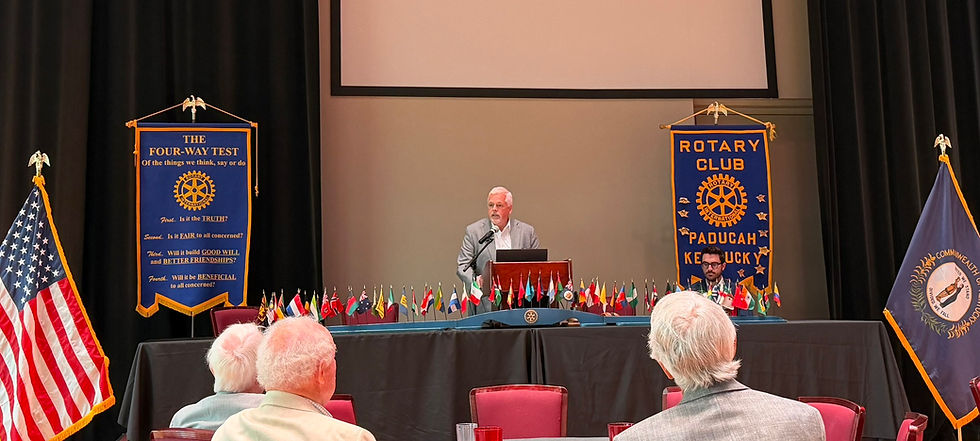
Michael Radcliffe, Chairman and Chief Executive Officer (CEO) of Community Financial Services Bank (CFSB), recently spoke to members of the Rotary Club of Paducah about the benefits, challenges and continued importance of community banks.
Radcliffe was invited to address the club by CFSB Investments’ Riley Solomon, who currently serves as president of the Rotary Club of Paducah. During the club’s Wednesday, July 8 meeting, Radcliffe shared lessons from his 38-year career in banking, discussed the leadership principles that have shaped his work and explained why locally owned financial institutions continue to play a vital role in the communities they serve.
Radcliffe began his banking career in 1988 as a drive-thru teller while attending Murray State University. From there, he moved into credit analysis, compliance and risk management before eventually assuming his current leadership role as CFSB’s Chairman and CEO.
Throughout his presentation, Radcliffe emphasized that strong organizations are built by helping people understand not only what they are being asked to do, but also why it matters. He explained that transparency, open communication and a culture in which team members feel comfortable speaking honestly are essential to effective leadership.
“Leadership isn’t about having all the answers,” Radcliffe said. “It’s about building the right team, being transparent about where things stand and creating an environment where people are willing to tell you the truth, even when it’s not what you want to hear.”
Radcliffe also reflected on his opportunity to testify before the U.S. House Financial Services Committee in Washington, D.C., where he advocated for regulations that recognize the distinct role and operating model of community banks.
“At its core, community banking is a simple model,” Radcliffe explained. “We take deposits from people in our communities, and we reinvest those funds right back into those same communities through small businesses, farmers and families buying homes. We make those decisions right here in Western Kentucky, and that matters.”
While acknowledging that responsible regulation plays an important role within the financial industry, Radcliffe discussed the increasing challenges community banks face when required to operate under many of the same expectations as the nation’s largest financial institutions. Rising compliance costs, rapidly changing technology, competition from non-bank financial platforms and continued industry consolidation all affect a community bank’s ability to serve local clients.
Radcliffe noted that when he began his career, approximately 16,500 FDIC-insured institutions operated across the United States. Today, that number has fallen to approximately 4,300. He also shared that the number of Kentucky census tracts without a bank branch increased from 65 in 2019 to 71 in 2025, leaving nearly 212,000 Kentuckians living in areas sometimes described as “banking deserts.”
“People may still have a smartphone in their pocket, but they don’t have a local banker nearby who knows them, understands their business or can sit across the table when they need help,” Radcliffe said. “If community banks disappear, it won’t just change banking. It will change our communities.”
CFSB’s own history reflects the need for strong local financial institutions. Originally chartered as the Bank of Benton by an act of the Kentucky General Assembly in 1890, the bank was established by local business leaders who believed the community needed greater access to financial services. During its more than 135-year history, the bank has navigated significant economic and societal changes while continuing to adapt to meet the evolving needs of the communities it serves.
“Our responsibility today is the same as it was 135 years ago: to adapt, to stay relevant and to make sure our communities still have strong local banks for the next generation,” Radcliffe said.
CFSB appreciates Solomon’s leadership within the Rotary Club of Paducah and the opportunity to join local business and community leaders for a meaningful conversation about the future of community banking.


